Author: Daniel Jordan Viray
Giving my drone “eyes” for indoor autonomous navigation
Apr 18, 2026 · Autonomy & Mapping · by Daniel Jordan Viray
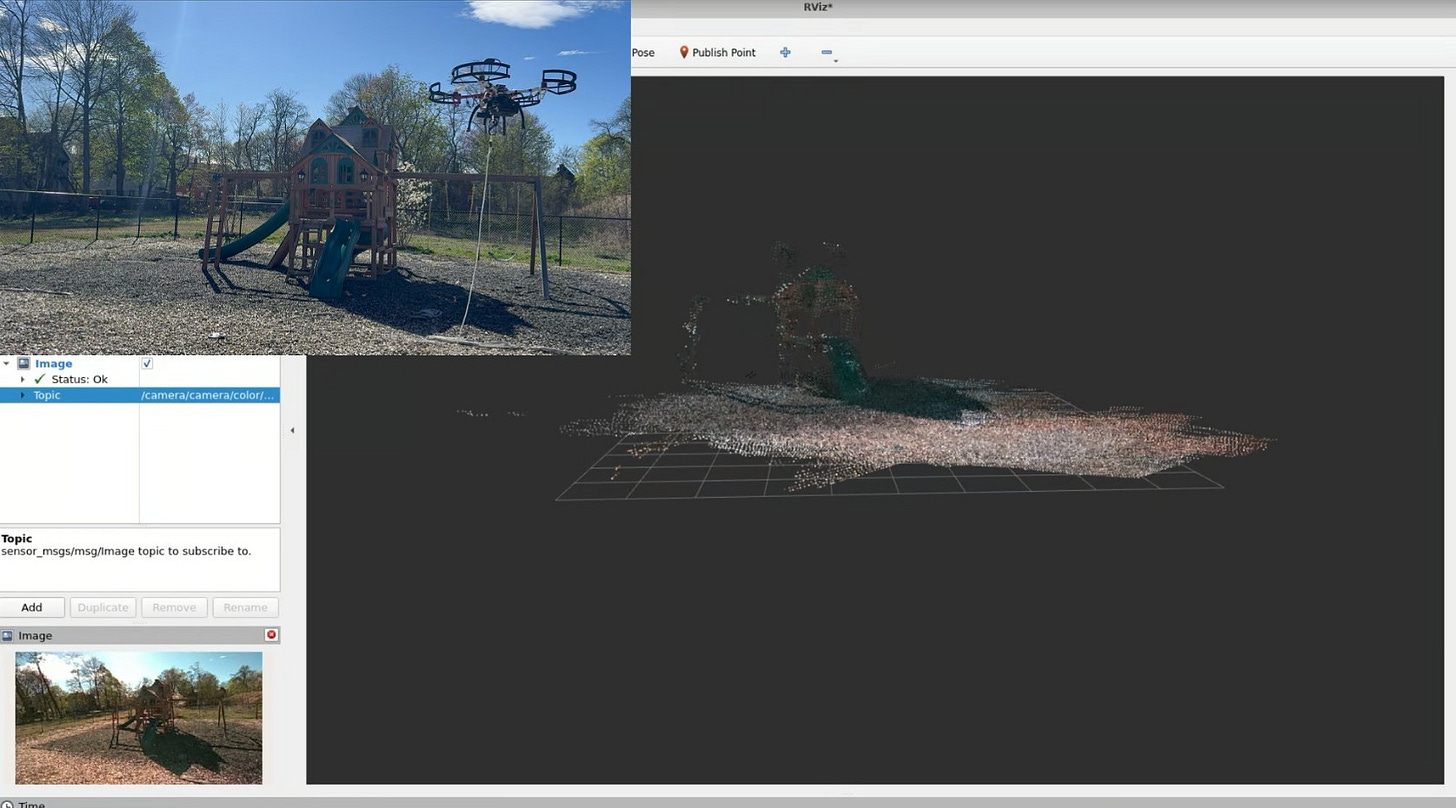
Got real-time 3D mapping to work with real flight! This mapping capability is important because it will give my drone a method for autonomous navigation without relying on GPS (satellite) signal.
Outdoor drones today rely on GPS for autonomous navigation. However, this reliance on GPS creates some problems: (1) there is no GPS signal indoors, (2) GPS signal can be spotty around buildings such as in cities, and/or (3) GPS can be intentionally jammed/interfered with. (And in NASA’s case, there is no GPS on the moon or on Mars — a real research initiative for NASA).
Additionally, mapping capabilities gives the drone the ability to avoid obstacles. Autonomous GPS navigation assumes there are clear paths between waypoints. But if there are buildings, power lines, or other obstacles in the way, those can result in dangerous and expensive crashes. (And there are plenty of documented cases of this happening.)
Hence why I am excited about getting this real-time mapping capability working with real flight.
If you’re interested in AI/robotics, let’s connect!
For documentation: one unrelated problem that came up during this test flight was that the drone seemed to fall out of the sky after about 17 minutes of total flight time. The drone seemed to be flying fine the whole time, but then after I triggered the auto “land” command, the drone seemed to like fall out of the sky in a landing position. This crash basically broke all the plastic mounts and propeller guards; thankfully, the camera and computer were undamaged, but the crash was quite violent.
My thinking was that this was a battery issue after 17 minutes of total flight time, which was actually quite a lot of flight time. I was using a 4S lipo 2200mah battery. Given that the drone is heavy with the equipment, my theory is that the motors were asking for too much thrust, the battery had a voltage sag, the motors stopped spinning fast enough for flight; hence the crash. After the crash, the computer and camera were still running for about 10 seconds or so, and then the computer disconnected from my laptop via hotspot (I think because of a voltage sag from the battery). When I got home, I checked the battery life and it was at 2%. So the battery may still have had some juice, suggesting maybe the battery wasn’t discharging fast enough? Or my battery reader is slightly inaccurate and the battery was dead, which would be a much simpler explanation for all of this.
My solution: I’m using 2212 920KV Brushless Motors, and I think they pair well with 3S lipo battery in terms of the amount of thrust they ask for from the battery, especially from a heavy drone. I.e., it’s not a lightweight sports drone that needs a lot of thrust from a 4s lipo battery. Hence, I’ve swapped the battery to a 3S 4500mah battery to see if that makes a difference. It should give lower thrust and longer flight time. Or, hopefully, the battery just died during flight and the solution is simply to not let the battery drain.
To be honest, I don’t know enough about voltage and motor pairings at this point to know for sure that this will work, but I think (hope) that it will and that the problem will be resolved.
Ok, so update on the battery problem. First, I thought it was a problem with a mis-calibrated compass on the GPS. Which was true, my GPS was loose and was probably causing loiter mode to go whack. But even after I recalibrated the compass, the drone was not flying consistently well on a 3S 4500mah battery. The problems: it would take off fine, but then it would struggle to hover. It slowly descended into the ground. And then sometimes, the drone would drift off from the loiter position. My guess is that when the wind blew the drone, the drone was too heavy for the motors to hold position. Now, when I switched to a 4s 2200mah battery (lighter and 4s), the drone flew correctly and held position against the wind. First thing I noticed about the 4s battery is that the motors audibly spun much faster, thereby I’m assuming generated more thrust. And it was able to respond with wind gusts better. Now, I was only to do one test flight because of battery life. But the 4s 2200mah battery was flying consistently well the last time, except for that one instance where the drone fell out of the sky. My guess is that the battery just died in this case and that’s why.
I’ve ordered bigger 1045 propellers (10 inch diameter), which are on the way. (I’m currently using 9450 (9.4 inch diameter) propellers on 2212 960kv brushless motors). I’m thinking the bigger propellers will give me more “free” thrust, assuming they fit in the propeller guard cages). But otherwise, I’ll use 4s 2200mah battery. Maybe I can upgrade to 4s ~4500mah but that will add weight to the drone. But it will give more flight time if it works.
Point is 3s (4500mah) isn’t going to cut it.
In a sense, I feel like I wasted time and money on buying and testing the 3s lipo battery. At the same time, that’s how science and engineering works, especially for unknown problems. You have to experiment, that’s what being a scientist and engineer is. Unfortunately, experimentation isn’t always efficient. But at least I have a systematic answers about 3s vs 4s lipo batteries, weight load, etc. Like that’s what it means to build this — this is exactly the journey. So when I feel like it was a waste of time and effort going down this route, I have to remind myself that this is the process of building an autonomous drone. If it was already solved perfectly, then there wouldn’t be a need to experiment.